AI Overviews vs. Traditional SEO: What Every Business Needs to Know in 2026
AI Overviews vs traditional SEO — the difference now decides whether your website gets clicks or gets skipped. If you’re a business owner watching your Google traffic slide even though your rankings “look fine,” you’re not imagining it. This is the story of how we got here, where things stand right now, and what’s coming next — and exactly what your business needs to do about it.
The Past: How Traditional SEO Worked (2010–2023)
For over a decade, SEO ran on a simple loop:
- Rank in the top 10 blue links for a keyword
- Get clicked
- Get traffic, leads, and revenue
Google’s job was to be a directory — it pointed you to the best page and got out of the way. Ranking factors like backlinks, keyword density, page speed, and domain authority determined who won that top spot, and winning it was the entire game.
This model rewarded a specific kind of content: comprehensive guides, well-optimized landing pages, and consistent publishing. Businesses that invested in this — including the early years of most Tricity-based agencies — built real, durable traffic this way.
Then came May 2024. Google launched AI Overviews, AI-generated summaries placed above the traditional blue links, answering the user’s question directly on the results page. Initially limited to Search Labs and a fraction of queries, it looked like a minor experiment.
It wasn’t.
The Present: Where Search Stands in 2026
AI Overviews are no longer experimental — they are core infrastructure. Here’s what the data shows as of mid-2026:
Scale and reach
- AI Overviews now appear on roughly 48% of all Google search queries, up sharply from under 15% a year earlier
- The feature spans over 200 countries and 40+ languages
- Coverage is highest for informational and comparison queries — comparison-style searches (“X vs Y”) trigger an AI Overview more than 95% of the time
The click-through collapse
- Organic CTR drops by roughly 34% to 61% when an AI Overview appears on a search result page
- Pew Research found only about 8% of users click a traditional result when an AI Overview shows up, versus 15% when it doesn’t — nearly half
- A large share of Google searches — estimates range from 60% to over 80% depending on query type — now end with zero clicks to any website at all
Who’s getting hit hardest
- Smaller, independent sites are losing search referral traffic at roughly triple the rate of large publishers
- Businesses relying on “how-to,” “what-is,” and comparison-style content — exactly the kind small businesses use to build authority — are the most exposed
- B2B and service businesses see AI Overview exposure on around 70% of their typical query types
The upside nobody talks about
- Brands that get cited inside an AI Overview see 35–120% more organic clicks than uncited competitors on the same query, plus a large lift in paid clicks
- Branded search queries with AI Overviews present are actually seeing CTR increase — AI Overviews are redistributing clicks toward trusted, cited sources rather than eliminating clicks altogether
- Citation overlap with the traditional top-10 rankings has weakened significantly — meaning pages that don’t rank #1 can still get cited and get traffic, if the content is structured right
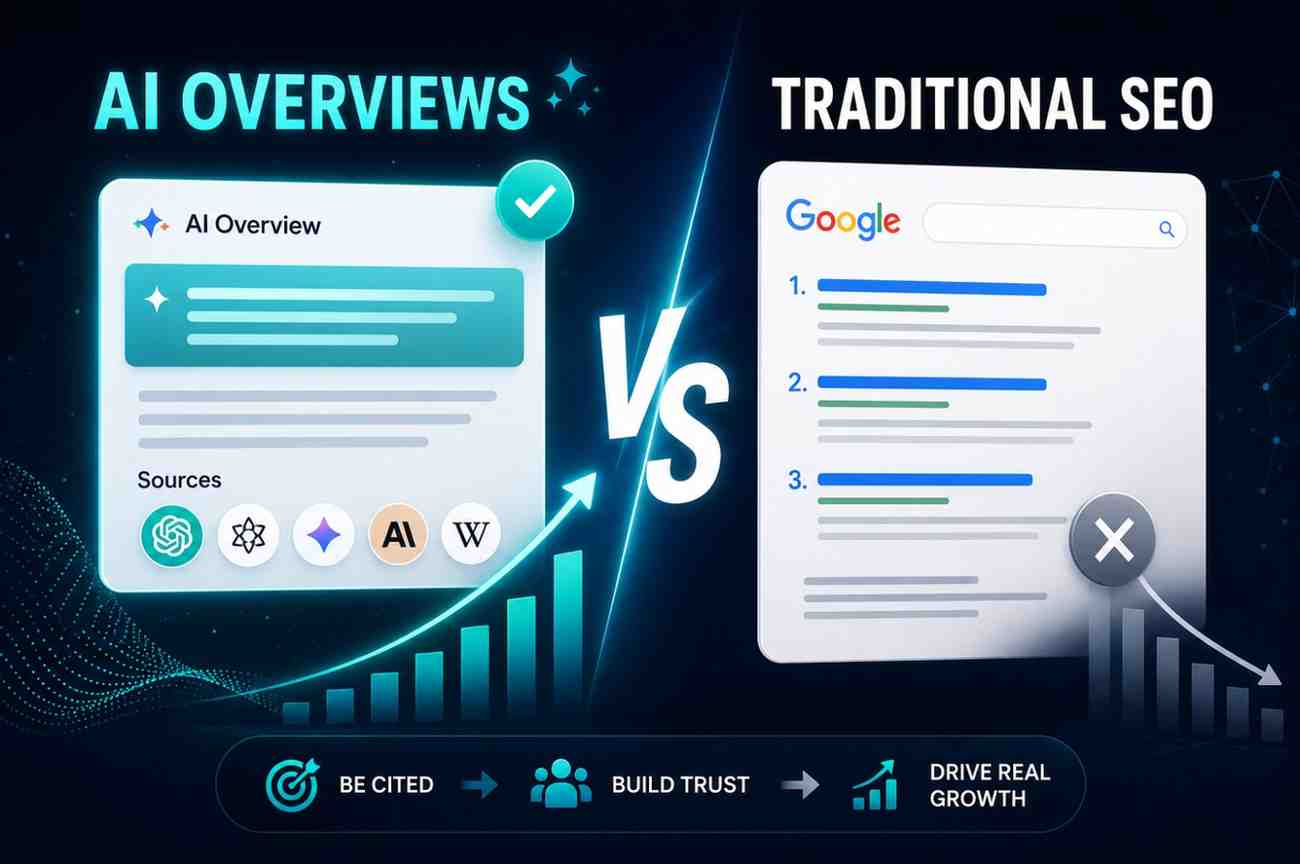
This last point is the single most important shift for a growing business to understand: ranking and being cited are no longer the same game. You can rank #1 and lose clicks. You can rank #14 and get cited — and get the click.
What Actually Changed (The Real Shift)
| Traditional SEO (Pre-2024) | AI Search Era (2026) |
|---|---|
| Goal: Rank #1 in blue links | Goal: Get cited inside the AI-generated answer |
| Success metric: Rankings + CTR | Success metric: Citations + brand mentions across AI surfaces |
| Content style: Keyword-optimized pages | Content style: Clear, structured, directly-answerable content |
| Where you compete: Google only | Where you compete: Google AI Overviews, ChatGPT, Perplexity, Gemini, AI Mode |
| Authority signal: Backlinks | Authority signal: Backlinks + entity consistency + structured data + real expertise |
Google itself is reacting. In May 2026, Google rolled out a set of updates widely read as a direct response to publisher and business pressure over the click decline — including new attribution and “Subscribed” labeling features for cited sources. This confirms what agencies like ours have been telling clients all year: visibility without traffic is now a real, measurable problem, and Google knows it.
The Future: Where This Is Heading
Based on the current trajectory, here’s what businesses should prepare for over the next 12–24 months:
- AI Mode expansion — Google’s more aggressive AI-first search experience (separate from AI Overviews) is rolling out further, with some data showing 90%+ of searches ending without a click when it’s active. This will accelerate the shift from “ranking” to “citation” strategy.
- Multi-platform visibility becomes mandatory — Businesses will need to actively manage their presence not just on Google, but on ChatGPT, Perplexity, Gemini, and Claude, since each platform sources and cites differently. This is the core of what Generative Engine Optimization (GEO) solves.
- Original data and real expertise win — AI systems struggle to replicate genuine research, first-party data, and documented experience. Generic, templated content is the first thing being replaced by AI summaries.
- Local and service businesses have an advantage — AI Overviews trigger far less often on transactional and local-intent queries. Businesses with strong Google Business Profiles, real reviews, and location-specific content are comparatively insulated — for now.
- Measurement itself is changing — Search Console impressions no longer reliably indicate traffic. Businesses will need citation tracking across AI platforms, not just keyword rank tracking, to understand real visibility.
What This Means for Your Business
If your website traffic has quietly dropped even though “nothing changed” on your end, this is very likely why. The businesses that will win the next two years of search are the ones that:
- Build content structured to be directly answerable and citable, not just keyword-optimized
- Maintain consistent entity information (name, service, location) across their website, Google Business Profile, and structured data
- Actively track and optimize for citations across Google AI Overviews, ChatGPT, Perplexity, and Gemini — not just Google rankings
- Keep investing in genuine local SEO and reviews, where AI disruption is currently weakest
This is exactly the dual-channel approach CredoRank builds for every client — ranking on Google and getting cited on AI platforms, so your visibility doesn’t depend on one algorithm’s mood.
Not sure where your business currently stands on AI platforms? Run a free AI visibility check and see exactly how you show up — or don’t — when your customers ask ChatGPT, Perplexity, or Gemini for a recommendation.
Sources referenced: Ahrefs, Seer Interactive, Semrush, BrightEdge, Pew Research Center, Reuters Institute/Chartbeat, SparkToro/Datos, Search Engine Land — 2025–2026 industry research on AI Overviews and generative search.