AI SEO
The Complete AI SEO Guide
Search stopped being ten blue links and became an answer. This is the full map — from Yahoo's human-edited directory in 1994 to agentic search in 2030 — for anyone who needs their site to be found, cited, and recommended by both engines and models.
📖Jump to any section (24 parts — click to collapse) ▾
- 02History of Search
- 03Birth of AI Search
- 04What is AI SEO
- 05How AI Search Works
- 06Google AI Search
- 07ChatGPT Search
- 08Perplexity SEO
- 09Gemini SEO
- 10Claude SEO
- 11Ranking Factors
- 12Technical AI SEO
- 13Content Strategy
- 14Local AI SEO
- 15Ecommerce AI SEO
- 16Tools
- 17Workflow
- 18Case Studies
- 19Common Mistakes
- 20Future 2027–2030
- 21Checklist
- 22Glossary
- 23FAQs
- 24Conclusion
- 01 · Introduction
- 02 · History of Search
- 03 · Birth of AI Search
- 04 · What is AI SEO
- 05 · How AI Search Works
- 06 · Google AI Search
- 07 · ChatGPT Search
- 08 · Perplexity SEO
- 09 · Gemini SEO
- 10 · Claude SEO
- 11 · Ranking Factors
- 12 · Technical AI SEO
- 13 · Content Strategy
- 14 · Local AI SEO
- 15 · Ecommerce AI SEO
- 16 · Tools
- 17 · Workflow
- 18 · Case Studies
- 19 · Common Mistakes
- 20 · Future 2027–2030
- 21 · Checklist
- 22 · Glossary
- 23 · FAQs
- 24 · Conclusion
Introduction
Why this guide exists, and how to read it depending on who you are.
Why everyone is suddenly talking about AI SEO
For twenty-five years, "being found online" meant one thing: ranking a blue link on Google. That link was the product. People clicked it, landed on your page, and you earned the visit. Somewhere around 2023–2025, that contract quietly broke. Search engines started answering questions directly, on the results page, without requiring a click. Then a second front opened: hundreds of millions of people started asking ChatGPT, Gemini, Perplexity, and Claude questions they used to type into Google — and those tools started citing, summarizing, and recommending sources of their own.
The result is that "ranking" no longer means one thing. It means: being the paragraph an AI Overview quotes, being the source Perplexity cites in its third footnote, being the brand ChatGPT recommends when someone asks "what's the best project management tool for a 5-person team," and still, underneath all of it, being the page that ranks in classic organic results — because most AI systems still lean on traditional search indexes to find candidates before they summarize them.
The shift from search engines to answer engines
A traditional search engine's job was retrieval: find the ten most relevant documents and let the human do the reading. An answer engine's job is synthesis: read many documents on the human's behalf and hand back a single, composed answer — with sources attached, sometimes, and not attached, often. That single change in job description rewrites almost everything about how visibility is earned. Relevance is no longer enough. A page now has to be extractable, quotable, structured in a way a model can lift a clean claim from, and trustworthy enough that a model is willing to attribute a claim to it at all.
How people search in 2026
The average person now moves fluidly between four modes in the same session: a classic Google search for something transactional ("plumber near me"), an AI Overview for something informational ("is creatine safe long term"), a conversational thread with ChatGPT or Claude for something that needs reasoning ("compare these three CRMs for my use case"), and a voice query to a phone assistant while driving. Each of these modes retrieves and ranks content differently, but they share a common upstream dependency: almost all of them are built on top of a crawled, indexed, embedded version of the web. That's the thread this guide follows from beginning to end.
Why businesses need to adapt
Two numbers explain the urgency. First, zero-click search — where the user gets their answer without visiting any website — has been rising for years and jumped again with AI Overviews and AI Mode. Second, referral traffic from AI answer engines, while still a fraction of classic organic traffic for most sites, is compounding month over month in a way organic search hasn't in a decade. A business optimizing only for the first kind of visibility is optimizing for a shrinking share of attention. A business that understands both is building distribution for the next ten years, not the last ten.
Who this guide is for
Marketers who need to explain the shift to a skeptical stakeholder. SEOs who want the technical mechanics of retrieval-augmented generation, not just a buzzword. Founders who want a checklist they can hand to a freelancer. And content teams who want to know, concretely, what "write for AI" actually means at the sentence level. Read Parts 2–5 for the why and how; skip straight to Parts 11–21 if you already believe the premise and want the playbook.
The History of Search
Most guides skip this in two paragraphs. It matters more than ever, because every AI ranking signal in 2026 is a descendant of a fight Google already had with spammers between 1998 and 2019.
Before Google: search as a filing cabinet
Search before 1998 wasn't really "search" in the modern sense — it was cataloguing.
- Yahoo Directory (1994) was not a search engine at all. It was a human-edited directory: real editors reviewed submitted websites and slotted them into categories, the same way a library assigns a Dewey Decimal number. Being listed depended on editorial approval, not algorithmic relevance.
- WebCrawler (1994) was one of the first engines to index full page text rather than just titles, which made it more useful but also easier to manipulate.
- Lycos (1994) combined a directory with keyword matching and ranked pages largely by how often a term appeared — the earliest version of what would later be abused as "keyword stuffing."
- AltaVista (1995) was the technically strongest engine of its era: fast, comprehensive, and among the first to support natural-language-ish queries. But it ranked almost entirely on-page — term frequency, term placement, meta tags — with no concept of authority.
- Ask Jeeves (1996) tried a different bet: a natural-language question box, answered partly by a human-curated knowledge base. It anticipated the "just ask a question" behavior answer engines would perfect two decades later, but the underlying technology couldn't scale.
The common weakness across all of them: relevance was measured by the page itself, not by what the rest of the web thought of the page. If you controlled the page, you controlled your ranking. That made these engines trivial to game with hidden text, keyword repetition, and doorway pages — exactly the gap Google's founders set out to close.
Google's revolution: 1998
Larry Page and Sergey Brin's insight was that a link from Page A to Page B is a vote — and not all votes are equal. A link from a page that itself has many trusted votes should count more than a link from an obscure page. That recursive idea became PageRank.
| Concept | What it means | Why it mattered |
|---|---|---|
| PageRank | A score representing how likely a random web surfer clicking links would be to land on a given page, based on the quantity and quality of inbound links. | Shifted ranking from "what the page says about itself" to "what the web says about the page" — the first real authority signal. |
| Backlinks | Links from other websites pointing to yours. | Became the primary currency of authority for the next 20+ years, and remains a factor in how LLMs judge which brands are worth citing. |
| Crawling | Automated bots (Googlebot) following links from page to page to discover URLs. | Made the index continuously self-updating rather than dependent on manual submission. |
| Indexing | Storing a processed, searchable copy of crawled pages in a massive database. | Separated "does this page exist" from "can we retrieve it instantly" — the same separation modern vector databases make today. |
| Relevance | Matching a query's intent to the closest documents in the index, combining on-page signals with authority signals. | The blend of relevance and authority is the direct ancestor of how RAG systems rank retrieved chunks before handing them to a language model. |
Evolution of SEO: 1998–2005, the arms race begins
As soon as webmasters understood links and keywords drove rankings, an entire industry of manipulation appeared almost overnight.
- Keyword stuffing — repeating a target phrase unnaturally throughout a page, sometimes in white text on a white background so only crawlers could "read" it.
- Meta keywords abuse — the meta keywords tag was meant to describe page topics; it was quickly filled with hundreds of unrelated terms, which is why Google stopped using it as a ranking signal by the mid-2000s.
- Hidden text and cloaking — showing crawlers a keyword-rich page while showing humans something entirely different.
- Link farms — networks of low-quality sites created solely to link to each other and inflate PageRank artificially.
Google's response to this era set the template it still follows: identify a manipulation pattern at scale, ship an update that penalizes it, and force the industry to compete on genuine quality instead. That pattern repeats through every update below — and it's the same pattern now playing out against AI-generated content farms and citation manipulation.
Google fights spam: the major algorithm updates
Birth of AI Search
Between 2022 and 2026, a handful of products retrained an entire generation of internet users to ask a question instead of typing keywords. Here's what each one changed.
OpenAI & ChatGPT
ChatGPT's late-2022 launch was the moment "just ask it" entered mainstream vocabulary. Once ChatGPT gained live web browsing, it stopped being a closed-book model and became a genuine search competitor — one that reads several pages, synthesizes them, and answers in prose instead of listing links.
Google Gemini
Gemini is Google's own foundation model, and it's now woven directly into Search itself (AI Overviews, AI Mode) as well as a standalone assistant. Its advantage over pure-play competitors is direct access to Google's index, Knowledge Graph, and real-time data.
Claude (Anthropic)
Claude approaches search with an emphasis on careful reasoning over retrieved sources and transparent citation of what it found, rather than presenting an answer as if it came from nowhere. It's increasingly used for research-style queries where the user wants to see the reasoning trail, not just a verdict.
Perplexity
Perplexity was built from day one as an "answer engine" rather than a chatbot with search bolted on. Every answer is structured around inline citations, making it the closest thing to a purpose-built AI-native search product — and a strong signal of what future citation-based search looks like generally.
Microsoft Copilot
Copilot pairs OpenAI's models with the Bing index, giving Microsoft a search product embedded directly into Windows, Edge, and Office. Its distribution advantage comes from being pre-installed in front of hundreds of millions of desktop users.
Grok (xAI)
Grok's differentiator is real-time access to X (formerly Twitter), giving it an edge on breaking news, live sentiment, and cultural conversation that other assistants have to wait for the web to catch up on.
DeepSeek
DeepSeek proved highly capable open-weight reasoning models could be trained at a fraction of the assumed cost, accelerating global adoption of AI-assisted research and search outside the handful of companies that previously dominated the space.
How these changed search behavior
Three behavioral shifts matter most for SEO. First, query length exploded — people type full sentences and follow-up questions into a chat box in a way they never did into a search bar, which rewards content that answers a specific, complete question rather than a fragment. Second, trust moved from the domain to the claim — a user reading an AI answer is trusting the synthesis, and only checks the source if something seems off, which raises the bar for factual precision on individual sentences rather than overall page authority. Third, research became multi-turn — a single "session" might touch five or six sources across three follow-up questions, meaning a brand can be part of an answer without ever being the top-ranked single result.
What is AI SEO?
"AI SEO" gets used as a catch-all, but it's really a family of related disciplines. Knowing which one you're actually doing changes what you optimize.
| Term | Focus | Primary target |
|---|---|---|
| SEO | Ranking in traditional organic search results | Google/Bing search results pages |
| AI SEO | Umbrella term for optimizing visibility across all AI-driven surfaces | AI Overviews, chatbots, answer engines, generally |
| AEO (Answer Engine Optimization) | Structuring content to directly answer specific questions concisely, so it can be lifted as "the answer" | Featured snippets, AI Overviews, voice assistants |
| GEO (Generative Engine Optimization) | Optimizing for inclusion and favorable framing inside AI-generated responses | ChatGPT, Gemini, Perplexity, Claude |
| LLMO (LLM Optimization) | Making content and brand information easy for a language model to learn, retrieve, and represent accurately, including during training and fine-tuning | Any LLM's internal knowledge and retrieval behavior |
| Entity SEO | Establishing your brand, product, or person as a clearly defined, disambiguated "entity" search engines can recognize | Knowledge Graphs, Knowledge Panels |
| Semantic SEO | Organizing content around topics, concepts, and relationships rather than isolated keywords | Embeddings-based and intent-based ranking |
| Knowledge Graph Optimization | Structuring data (schema, Wikidata, consistent facts) so engines can map you as a node with defined attributes and relationships | Google Knowledge Graph and similar structured databases |
| Answer Engine Optimization | Often used interchangeably with AEO above — writing to be the extracted answer, not just a ranked link | Any surface that presents a single synthesized answer |
In practice, these overlap heavily and most of this guide treats "AI SEO" as the umbrella covering all of them, calling out the specific discipline only where the tactic diverges. For a deeper, dedicated breakdown of GEO specifically — including how citation criteria differ from ranking criteria — see CredoRank's full guide to Generative Engine Optimization.
How AI Search Works
The mechanics behind every AI answer, in the order they actually happen.
1. Crawlers
Before an AI system can retrieve anything, a bot has to have visited the page. Google's crawler (Googlebot) and each AI provider's own crawler (for example, dedicated bots run by OpenAI, Anthropic, Perplexity, and Common Crawl, a shared archive many models train and retrieve from) follow links and sitemaps to discover URLs, download their content, and pass it downstream for processing. If a crawler can't access a page — blocked by robots.txt, gated behind a login, or rendered only after heavy JavaScript execution the bot doesn't run — nothing after this step can happen. Crawling is the floor everything else stands on.
2. Indexes
Once crawled, a page is processed and stored in a searchable index — essentially a giant, structured lookup table mapping words, phrases, and entities to the documents that contain them. Classic search indexes are optimized for fast keyword and phrase lookup. Most AI systems that "search the web" in real time are actually querying one of these classic indexes first (their own, or a licensed one like Bing's) to shortlist candidate pages, before any language model reasoning happens.
3. Knowledge Graphs
A Knowledge Graph stores facts as connected entities and relationships — "CredoRank" → "is a" → "SEO agency" → "founded in" → "2019" — rather than as plain text. This lets an engine answer factual questions directly and consistently, and lets it disambiguate between similarly-named things (a person, a company, and a book that share a name, for instance). Consistent facts about your brand across your website, Wikipedia, Wikidata, and business listings make it far more likely you're represented correctly in a Knowledge Graph node.
4. Embeddings and vectors
An embedding is a numerical representation of meaning: a chunk of text gets converted into a long list of numbers (a vector) positioned in a mathematical space where semantically similar content ends up physically close together, regardless of exact wording. This is what lets a system match "how do I stop my dog from barking at the mailman" to a page titled "reducing reactive barking in dogs" even though barely a word overlaps. Vector search is why keyword matching alone stopped being sufficient somewhere around Hummingbird and BERT, and why topical depth now matters more than exact-match keyword density.
5. Retrieval
Retrieval is the step where a system takes the user's query, converts it into the same vector space (and/or a classic keyword query), and pulls back the most relevant chunks of content from the index — typically the top 10–50 candidates, well before any generation happens. Everything in Parts 11–13 of this guide exists to improve your odds of being one of those candidates.
6. Retrieval-Augmented Generation (RAG)
RAG is the architecture that ties it together: retrieve relevant documents first, then feed those documents into a language model's context window alongside the user's question, and ask the model to generate an answer grounded in what was retrieved — rather than relying purely on what the model memorized during training. This is why a chatbot with live search access can answer about this week's news even though its training data is months old: it isn't recalling, it's reading, in real time, off the documents retrieval just handed it.
7. Context windows
A context window is the amount of text a model can "hold in mind" at once when generating a response — measured in tokens, roughly word-fragments. Retrieved documents have to fit inside this window alongside the conversation history and the model's own instructions. Larger context windows let a model consider more retrieved sources at once, but every system still has to choose which chunks make the cut — which means concise, well-structured, front-loaded content survives that cut more often than sprawling, unstructured pages.
8. Ranking (within retrieval)
Retrieved candidates aren't fed to the model in random order — they're re-ranked using a mix of relevance score, source authority, freshness, and sometimes user engagement data, before the highest-ranked chunks are passed into the context window. A page can be "in the index" and still never make it into an actual answer if it consistently ranks below the cutoff at this stage.
9. Citation generation
Once the model has generated an answer, many systems separately determine which retrieved sources to visibly cite — this is often a distinct step from generation itself, matching specific claims in the output back to the specific documents that supported them. This is why you sometimes see an AI answer cite a source that doesn't perfectly match the phrasing of the claim: the citation step is approximate, not a perfect audit trail.
10. Freshness
For time-sensitive queries, retrieval systems weight recently published or recently updated content more heavily, and may apply an explicit "freshness" filter before ranking even starts. A well-written page from 2019 can lose to a mediocre page from last month on a fast-moving topic purely on recency.
11. Confidence
Models generate a form of internal confidence about a claim based on how consistently it appears across retrieved sources. A fact repeated, consistently phrased, and corroborated across multiple independent sources is more likely to be stated plainly; a fact found in only one source, or contradicted elsewhere, is more likely to be hedged ("some sources suggest...") or omitted entirely.
12. Source selection
Finally, when multiple candidate sources say roughly the same thing, systems have to choose which ones to surface or cite. This is where brand authority, domain trust, author credentials, and structural clarity break ties — the same original content, published on an obscure unverified blog versus an established, well-cited domain, does not get treated equally, even if the words are identical.
Google AI Search
Google's AI features aren't a separate product bolted onto Search — they're Search's core ranking pipeline feeding a generation layer built on Gemini.
AI Overviews
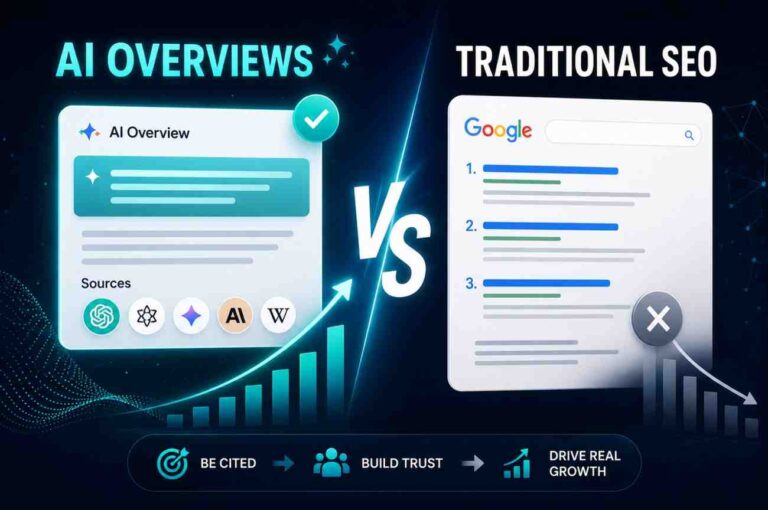
AI Overviews synthesize multiple top-ranking pages into a short answer block above traditional results, with linked citations to a handful of sources. They tend to appear for informational, "how/why/what is" style queries more than transactional ones. Because the sources cited are drawn from pages that were already ranking well organically, the single most reliable way to appear in an Overview is still to rank well organically for the underlying query — AI Overviews amplify existing rankings more than they create entirely new ones. For a closer look at exactly what's changed in click-through behavior since Overviews rolled out, see CredoRank's AI Overviews vs. Traditional SEO breakdown.
AI Mode
AI Mode is a fuller conversational search experience: it breaks a complex question into sub-questions, runs multiple retrieval passes, and returns a longer synthesized response with a wider set of linked sources than a standard Overview, supporting natural follow-up questions in the same thread. It rewards content that thoroughly answers a topic's adjacent questions, not just the primary query. Google's own AI features documentation confirms there's no separate ranking system for these features — standard SEO fundamentals remain the baseline.
From Search Generative Experience to today
"Search Generative Experience" (SGE) was the original experimental name for what became AI Overviews and AI Mode as they graduated from a labs experiment into the default Search experience for a large share of queries.
Gemini integration
Gemini isn't confined to a chat window — it's the model reasoning inside AI Overviews and AI Mode, and it's increasingly the model summarizing content inside Google Workspace, Android, and Chrome. A single well-optimized page can therefore surface across several Google-owned surfaces simultaneously, not just the classic results page.
Shopping AI
Google's shopping features use AI to compare products across price, reviews, and specifications, generating comparison-style answers rather than a plain product grid. Structured product data (price, availability, reviews, specs via schema markup) is what makes a product eligible to be pulled into these comparisons at all.
Local AI
Local search increasingly blends AI Overview-style synthesis with Google Business Profile data — summarizing what reviews say about a business rather than just listing star ratings. Consistent, detailed, frequently updated business profile data feeds this directly (see Part 14).
Multimodal search
Google increasingly accepts and reasons over images and voice as query input (Google Lens-style search, "search what's on my screen"), meaning discoverability now depends partly on image alt text, captions, and structured visual data — not text alone.
ChatGPT Search
ChatGPT's search layer runs on a mix of its own crawler and a licensed Bing index, which makes classic Bing SEO more relevant to LLM visibility than most marketers assume.
How ChatGPT finds websites
When ChatGPT needs current information, it issues queries to its retrieval system, which returns candidate web pages largely sourced through Bing's index and its own crawling activity, then reads and summarizes the top results before answering. Pages that don't appear in Bing at all are far less likely to surface here, even if they rank well on Google.
How citations work
ChatGPT typically attaches a small number of linked source citations to specific claims in its answer, favoring pages that state a claim clearly and early rather than burying it in the fifth paragraph. Content written with a direct, quotable answer near the top of a section is disproportionately likely to be the one cited.
How Bing influences results
Because of the Bing dependency, fundamentals of Bing SEO matter here specifically: verified Bing Webmaster Tools setup, clean XML sitemaps, and Bing's historically stronger weighting of exact keyword match and clear, older domain history than Google's more semantic approach.
Brand mentions
Beyond live web citations, ChatGPT's underlying model also carries baked-in knowledge from its training data — meaning how consistently and accurately your brand is described across the wider web (news coverage, review sites, Wikipedia, forums) shapes what the model "knows" about you even before it runs a live search.
Freshness and authority
ChatGPT search weighs recency for time-sensitive queries similarly to other engines, and leans on established-domain trust signals when multiple sources conflict — new, unverified domains are less likely to be the tie-breaking citation on a contested claim.
Perplexity SEO
Perplexity was purpose-built around citations, which makes it the clearest lab for understanding what "GEO" actually rewards.
How Perplexity cites sources
Nearly every sentence of factual claim in a Perplexity answer carries a small numbered citation linked to a specific source, visible inline rather than bundled at the end. This granularity means a single page can earn multiple citations within one answer if it's genuinely the best source for several distinct claims — rewarding depth and specificity within a page, not just topical relevance.
Authority weighting
Perplexity has been reported to favor a mix of established news outlets, primary sources, and high-authority reference sites when multiple candidates make the same claim, similar to how traditional search weighs domain trust when relevance is roughly tied.
News
For current-events queries, Perplexity leans heavily on recently published journalism, often citing multiple outlets covering the same story rather than a single source — meaning fast, accurate initial coverage of a breaking topic in your niche can earn outsized citation share.
Academic papers
For technical, scientific, or health-related queries, Perplexity frequently pulls from academic and research databases directly, which is worth knowing if your brand publishes original research or data — being indexed and cited as a primary source outranks being summarized secondhand by a blog.
Websites generally
For everyday informational and commercial queries, Perplexity behaves like a stricter version of Part 5's retrieval pipeline: clear, well-structured, single-topic pages that state a direct answer early are consistently favored over sprawling, multi-topic pages that bury the point.
Gemini SEO
Gemini's biggest structural advantage over ChatGPT and Perplexity is that it isn't a search layer bolted onto a chat model — it has native access to Google's own infrastructure.
How Gemini differs from ChatGPT
Where ChatGPT's search depends on a licensed Bing index, Gemini (inside AI Overviews, AI Mode, and the standalone Gemini app) can draw directly on Google's own crawl, index, and decades of ranking signal — meaning traditional Google SEO fundamentals translate to Gemini visibility more directly than they translate to ChatGPT visibility.
Google Index dependency
A page has to be indexed by Google and eligible to rank organically before it can realistically be surfaced by Gemini-powered features — there's no separate "AI index" to optimize for independently of the core organic index.
Knowledge Graph
Gemini draws on Google's Knowledge Graph for factual, entity-based questions, which is why consistent structured data and a well-defined entity presence (Part 4) disproportionately benefits Gemini-surfaced answers about people, places, and organizations.
Search integration
Because Gemini effectively is the model inside Google's own AI search features, optimizing for AI Overviews and AI Mode (Part 6) and optimizing for "Gemini SEO" are, in practice, close to the same task.
Multimodal reasoning
Gemini was built from the ground up to reason across text, images, and video rather than having multimodal support added afterward, which is part of why Google's search features are further along in accepting image and voice queries than most competitors. A page with well-captioned images, transcribed video, and descriptive alt text gives Gemini-powered search more to work with than text alone.
Workspace & ecosystem reach
Because Gemini also sits inside Gmail, Docs, and Android, brand and content signals can reach users through summarization features in products that were never traditionally thought of as "search" at all — for instance, a Gemini-powered summary of a document or email thread referencing your product name. This is a newer, less measurable channel, but it's a reason consistent, unambiguous brand language matters even outside search-specific content.
Claude SEO
Claude, built by Anthropic, takes a more visibly research-oriented approach to search than some competitors — which changes what "being cited by Claude" actually rewards.
Anthropic's approach
Claude is designed to reason carefully over the sources it retrieves and to be transparent about what it did and didn't find, rather than presenting a synthesized answer with the retrieval step hidden. That design choice tends to favor sources that make their own reasoning and evidence explicit — pages that show their work (data, methodology, dates, named sources) rather than asserting conclusions with no visible support.
Web search behavior
When Claude uses live web search, it issues targeted queries, reads the retrieved pages, and reasons about which of them actually answer the question before drafting a response — closer to how a careful researcher would triage sources than to a single-shot summarization.
Sources
Because Claude tends to weigh how well a source supports a specific claim rather than just how authoritative the domain is in general, a smaller, highly specific page that directly and clearly answers a niche question can out-compete a larger, more generic authority page that only touches the topic briefly.
Reasoning
For genuinely complex or comparative questions, Claude's extended reasoning step means it's more likely to synthesize several sources with differing framings and note where they disagree, rather than picking one dominant source and echoing it — which rewards brands that publish clear, well-labeled data and methodology over brands that rely on assertive claims alone.
Copyright-conscious summarization
Claude is deliberately cautious about reproducing large verbatim passages from sources, favoring paraphrase and short attributed quotes over long extraction. Practically, this means the content most likely to be accurately represented is the content that states its core claim plainly and briefly, since a short, clear sentence paraphrases cleanly, while a claim buried in a long, qualifier-heavy paragraph is more likely to be summarized loosely or dropped.
What this means for structure
Pages that clearly separate claims from supporting evidence — a plain statement followed by the data or reasoning behind it — tend to translate well into Claude's research-style answers, because the model can cite the claim and point to the specific evidence that backs it, rather than having to disentangle the two from a single dense paragraph.
AI SEO Ranking Factors
No engine publishes a definitive ranking factor list. This is a synthesis of what's consistently observable across Google's own documentation, independent citation studies, and how the retrieval pipeline in Part 5 actually behaves. Grouped by category.
Authority & Trust
Domain authority / trust history
Older, consistently reputable domains break ties when multiple sources say the same thing.
Backlink quality
A handful of links from respected, relevant sites outweighs hundreds of low-quality ones.
Brand mentions (unlinked)
Being talked about, even without a hyperlink, feeds the association models learn about your brand.
Third-party review signals
Independent reviews on external platforms corroborate your own claims about quality.
Wikipedia / Wikidata presence
Heavily weighted as a neutral, structured source for entity facts.
PR & press coverage
Independent journalism about you is treated as corroboration, not marketing.
Consistency of facts across the web
Contradictory info about your name, founding date, or claims erodes model confidence.
Author credentials
Named, credentialed authors with a visible track record outrank anonymous content on E-E-A-T-sensitive topics.
Content Quality & Structure
Direct-answer clarity
A clear, quotable answer in the first 1–2 sentences of a section gets extracted more often.
Topical depth
Comprehensive coverage of a subject beats a thin page that only touches the surface.
Original research / data
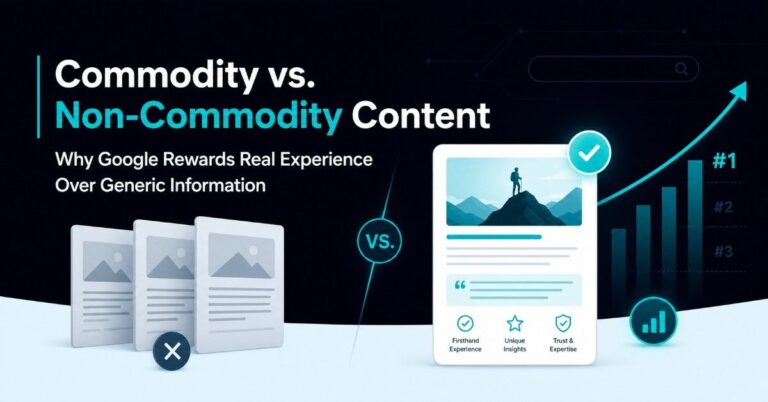
Proprietary statistics and studies are exactly what gets cited when no other source has them. See CredoRank's commodity vs. non-commodity content breakdown for why this matters more than volume.
Freshness / update frequency
Visible, genuine updates (not just a changed date) matter more on fast-moving topics.
Readability & structure
Clear headings, short paragraphs, and logical flow make content easier for a model to chunk and extract.
Single-topic focus per page
Pages trying to rank for ten unrelated things dilute the semantic signal for all of them.
Question-and-answer formatting
Explicit Q&A sections map directly onto how conversational queries are phrased.
Statistics with clear sourcing
A cited number is trusted; an uncited number is treated with more skepticism.
Multimedia (images, video, diagrams)
Supports multimodal retrieval and increases perceived depth and usefulness.
Case studies / examples
Concrete, specific examples are harder to find elsewhere and more likely to be the unique citation.
Content length (as a byproduct, not a goal)
Longer content correlates with topical depth, but padding without substance doesn't help.
Internal linking
Helps both crawlers and models understand topical relationships between your pages.
Avoiding AI-generated filler
Generic, derivative AI writing with no original insight is actively demoted by Helpful Content-style systems.
Entity & Knowledge Graph
Structured entity data
Schema markup that clearly defines who/what you are (Organization, Person, Product).
Author & "about" pages
A real, detailed About page and author bios help disambiguate the entity behind the content.
Knowledge Panel presence
Signals Google has already verified you as a distinct, defined entity.
Consistent NAP / brand data
Name, address, and core facts matching exactly across every platform prevents fragmentation.
Topical authority mapping
A body of interlinked content that fully covers a topic area, not just isolated posts.
Technical & Access
Crawlability
If a bot can't access it, none of the above matters at all.
Page speed / Core Web Vitals
Slow pages get crawled less frequently and rank worse on classic organic, which starves AI citation too.
Mobile usability
Still evaluated primarily on the mobile rendering of a page.
Clean, semantic HTML
Easier for both crawlers and extraction models to parse than div-soup layouts.
Structured data validity
Broken or incorrect schema can be ignored entirely or actively mislead an engine.
Accessibility
Alt text, proper heading hierarchy, and semantic markup double as machine-readability signals.
Server reliability / uptime
Frequent downtime during crawl attempts damages trust and freshness scoring.
HTTPS / basic security hygiene
Table-stakes trust signal for both crawlers and users.
Off-Page & Engagement
Citation frequency across other AI answers
Being cited elsewhere is itself a signal that compounds — models notice consensus.
Social proof & discussion volume
Being genuinely discussed (forums, communities) adds corroborating context beyond your own site.
Click-through & engagement on organic results
Still feeds classic ranking, which upstream feeds AI Overview eligibility.
Review volume & recency
Especially weighted for local and product-comparison queries.
Cross-platform presence
Appearing consistently across your site, social, directories, and press reduces the model's uncertainty about who you are.
Content licensing / crawl permissions
Explicitly allowing reputable AI crawlers (rather than blanket-blocking them) is a prerequisite for citation at all.
No engine weights all 40 identically, and weights shift with every model update — treat this as a comprehensive checklist to work through, not a formula to reverse-engineer.
Technical AI SEO
The infrastructure layer. Get this wrong and no amount of good writing matters, because nothing gets crawled, parsed, or indexed correctly in the first place.
robots.txt
This file at your domain root tells crawlers what they may and may not access — and increasingly, site owners use it to explicitly allow or block specific AI crawlers by user-agent (for example, distinct rules for search crawlers versus AI training/retrieval crawlers). Blocking every AI bot by default is an increasingly common but often self-defeating move: it can protect content from training use, but it also removes you from citation eligibility in tools that respect the same directive for retrieval.
XML sitemaps
A structured file listing every important URL on your site, helping crawlers discover pages faster than they would via links alone — especially valuable for large sites or newly published content that hasn't accumulated internal links yet.
LLMs.txt
Schema markup
Structured data (JSON-LD is the current standard format) that explicitly labels what a piece of content is — an Article, Product, FAQ, HowTo, Organization, Person — so engines don't have to infer it. The full current vocabulary lives at schema.org, the shared standard maintained jointly by Google, Microsoft, and other major search providers. This is one of the highest-leverage technical investments available, because it directly feeds both classic rich results and AI entity understanding.
Canonical tags
Tell engines which version of a page is the "real" one when duplicate or near-duplicate content exists (common with URL parameters, print versions, or syndicated content) — preventing your own authority from being split across multiple near-identical URLs.
Pagination
Proper handling of multi-page content (rel next/prev conventions, or consolidated single-page alternatives) so crawlers understand a paginated series is one connected body of content rather than fragments.
JavaScript & rendering
Content that only appears after client-side JavaScript executes is a real risk: not every crawler renders JS reliably or promptly, and some AI retrieval systems fetch raw HTML without executing scripts at all. Server-side rendering or static generation for core content remains the safest approach for maximum crawler compatibility.
Core Web Vitals
Google's specific metrics for loading speed, interactivity, and visual stability. They're a ranking factor in classic search and, by extension, an eligibility factor for AI Overviews that draw from top organic results.
Indexing
Being crawled doesn't guarantee being indexed — pages can be crawled and then excluded for quality, duplication, or noindex tag reasons. Regularly checking index coverage (via Search Console or equivalent) catches pages that quietly never made it in.
Structured content patterns
Beyond schema, the actual prose structure matters: clear H2/H3 hierarchy, one idea per paragraph, tables for comparisons, and explicit definitions set off from surrounding text all make a page easier to chunk correctly during retrieval.
APIs & feeds
For frequently changing data (pricing, inventory, live stats), exposing a clean API or structured feed gives AI systems a reliable, current source to pull from — rather than forcing them to parse a rendered page that may lag behind reality.
Content Strategy for AI Search
Structure that maps a topic the way a model's embedding space maps it: as a connected cluster of concepts, not a scattered pile of blog posts.
Topic clusters
A cluster is one pillar page covering a broad topic comprehensively, surrounded by supporting pages that each go deep on one sub-question, all interlinked. This mirrors how vector retrieval actually groups content — pages that are topically adjacent and clearly cross-referenced reinforce each other's relevance for the whole cluster.
Semantic SEO in practice
Writing to cover a concept fully — its definitions, causes, comparisons, and exceptions — rather than optimizing narrowly for one exact keyword phrase. This naturally captures the long tail of conversational queries an AI system will paraphrase in dozens of different ways.
Entity SEO in practice
Explicitly naming and defining the people, organizations, products, and places your content discusses, and linking them (via schema and plain text) to their canonical identity elsewhere on the web, so engines can disambiguate you from anything similarly named.
Topical maps
A deliberate outline of every subtopic, question, and comparison within your subject area before you write a single article — built once, then used to identify genuine content gaps rather than publishing reactively.
Content hubs & pillar pages
A pillar page (like this guide) acts as the comprehensive entry point and internal-linking hub for an entire subject, giving both crawlers and readers one authoritative place to start.
Internal linking
Deliberate, descriptive-anchor-text links between related pages that make the topical relationships explicit rather than implicit — helping both classic crawlers and retrieval systems understand which pages belong to the same cluster.
FAQs
Dedicated FAQ sections (ideally marked up with FAQ schema) directly match the question-and-answer format most conversational queries arrive in, and are disproportionately likely to be lifted verbatim into AI answers when phrased clearly and concisely.
Original data
Surveys, internal usage statistics, or proprietary benchmarks that don't exist anywhere else on the web are the single most reliable way to be the exclusive citation for a specific claim, rather than one of many interchangeable sources saying the same thing.
Case studies
Specific, real, detailed accounts of an outcome — client names (with permission), numbers, timelines — are far harder for competitors or AI-generated content to replicate than generic advice, which makes them durable citation magnets.
AI SEO for Local Businesses
Local queries increasingly get answered with an AI-synthesized summary of reviews and business data rather than a plain map pin — which changes what "showing up" locally requires.
Google Business Profile
Your Business Profile is now a primary data source for AI-generated local summaries, not just a map listing — complete categories, hours, services, attributes, and posts all feed directly into how an engine describes your business.
Reviews
Review volume, recency, and specific content (what reviewers actually say you're good at) get synthesized into AI answers about "the best X near me" — a business with fifty detailed, recent reviews mentioning specific strengths outperforms one with two hundred generic five-star ratings and no detail.
NAP consistency
Name, Address, and Phone number matching exactly across your website, Business Profile, directories, and citations prevents an engine from treating you as multiple ambiguous entities or losing confidence in your basic facts.
Local entities
Being clearly associated with the specific neighborhoods, landmarks, and service areas you actually serve — in structured data and plain text — helps disambiguate "near me" queries correctly.
City & location pages
Genuinely distinct, useful pages for each city or region you serve (not templated copies with the city name swapped) give engines specific, locally-relevant content to retrieve rather than one generic page trying to rank everywhere.
Maps
Accurate map placement and service-area boundaries remain foundational — AI synthesis sits on top of correct location data, it doesn't substitute for it.
AI SEO for Ecommerce
Product discovery is shifting toward AI-generated comparisons and recommendations — meaning structured, complete product data now competes directly with persuasive copy for importance.
Products
Complete, accurate product information (materials, dimensions, compatibility, use cases) gives AI shopping features enough structured detail to include you confidently in a comparison, rather than skipping you for a competitor with fuller data.
Schema
Product schema — price, availability, ratings, brand, GTIN/SKU — is close to mandatory for eligibility in AI-generated shopping comparisons and rich shopping results.
Reviews
Genuine, detailed product reviews (with Review schema) feed directly into AI-generated pros/cons summaries, which increasingly stand in for the comparison shopping research a buyer used to do manually across multiple tabs.
Images
Clear, well-labeled product images with descriptive alt text support multimodal product search and visual comparison features.
Shopping AI & Merchant Center
Keeping product feeds (via Merchant Center or equivalent) accurate and current is what actually powers AI-driven shopping comparisons — a beautiful product page with a stale or missing feed still won't surface in these features.
AI SEO Tools
A working toolkit, split by what each one is actually good for.
| Tool | Use it for |
|---|---|
| ChatGPT / Gemini / Claude / Perplexity | Directly testing how each engine currently answers your target queries and whether/how it cites you — the fastest feedback loop available, and free. |
| Semrush / Ahrefs | Traditional keyword research, backlink analysis, competitor gap analysis, and increasingly, AI Overview and LLM-citation tracking features. |
| Screaming Frog | Full-site technical crawls to catch indexing blockers, broken schema, redirect chains, and crawlability issues at scale. |
| Google Search Console | Ground truth on what's actually indexed, what's ranking, click-through rates, and increasingly, visibility into AI Overview appearances for your queries. |
| Bing Webmaster Tools | Directly relevant given ChatGPT and Copilot's dependence on the Bing index (Part 7); also surfaces IndexNow submission for faster crawl. |
| Schema validators (e.g. Rich Results Test) | Confirming structured data is technically valid before assuming it's helping. |
| PageSpeed Insights / Lighthouse | Diagnosing Core Web Vitals issues that gate both organic ranking and AI Overview eligibility. |
| Log file analyzers | Confirming which crawlers (including specific AI bots) are actually visiting your site and how often, rather than assuming. |
No single tool answers the whole question of "are we visible in AI search." The realistic workflow pairs a manual query-testing habit across the major assistants with a traditional SEO platform for the underlying technical and authority signals that make citation possible in the first place.
AI SEO Workflow
How a structured agency engagement actually runs, end to end. If you're weighing whether to run this in-house or bring in an agency, CredoRank's SEO pricing guide for India breaks down what each budget tier actually includes.
Case Studies
Illustrative scenarios based on common patterns we see across AI SEO engagements — composite examples, not disclosures of specific client data.
A SaaS company added a data-backed comparison page
A project-management tool replaced a generic "best alternatives" listicle with an original page comparing itself to five competitors using its own usage data, published as a table with schema markup.
Pattern: became the source cited in AI comparison answers for its category within weeks, largely because no competitor had published original comparative data.
A local clinic rewrote FAQ content around real patient questions
Instead of generic service descriptions, the practice published direct, specific answers to the exact questions patients asked at intake, marked up with FAQ schema.
Pattern: increased appearances in AI Overviews for symptom- and treatment-related local queries.
An ecommerce brand blocked all AI crawlers by default
Concerned about content scraping, the site blanket-blocked every AI user-agent in robots.txt, including retrieval crawlers used for live citation, not just training.
Pattern: disappeared entirely from AI shopping comparisons and answer engines, even for branded queries.
A content site mass-published AI-generated articles with no original insight
Hundreds of generic, templated posts went up in a short window with no unique data, examples, or perspective.
Pattern: organic visibility declined following a Helpful-Content-style quality signal, and citation rate stayed at zero throughout.
A B2B tool consolidated ten thin blog posts into one pillar guide
Instead of ten separate 600-word posts loosely covering the same topic, the team merged them into a single deep guide with clear sections and internal links replacing the old posts.
Pattern: consolidated authority meant the single page began appearing consistently as the cited source, instead of splitting citation potential across ten weak competitors of itself.
A retailer's product pages had no schema and inconsistent stock data
Rich, well-written product descriptions existed, but price and availability data wasn't marked up and frequently lagged real inventory.
Pattern: excluded from AI shopping comparisons entirely, since structured, reliable data mattered more than the quality of the prose.
Common Mistakes
The recurring failure patterns across audits, grouped by category.
Technical mistakes
- Blanket-blocking every AI crawler, including retrieval bots you'd actually want indexing you.
- Core content only rendering after heavy client-side JavaScript.
- No XML sitemap, or a sitemap that's badly out of date.
- Broken or missing schema markup that validators flag as invalid.
- Slow page speed causing reduced crawl frequency.
- Accidentally noindexing important pages.
- Duplicate content with no canonical tag resolving it.
- Orphaned pages with no internal links pointing to them.
- Ignoring mobile rendering while optimizing only the desktop layout.
- Treating llms.txt as a ranking requirement instead of an experimental hedge.
Content mistakes
- Burying the direct answer three paragraphs into a section.
- Publishing thin, templated pages purely to target keyword variations.
- Mass-publishing AI-generated content with no original insight or editing.
- Making claims and statistics with no visible sourcing.
- Writing one sprawling page trying to rank for ten unrelated topics.
- Never updating older content, even on fast-moving topics.
- Copying competitor structure and claims instead of adding something genuinely new.
- Skipping FAQ sections entirely on pages that answer clear, discrete questions.
- Using clever headlines that obscure rather than state the topic.
- No original data, research, or case studies anywhere on the site.
Entity & authority mistakes
- Inconsistent business name, address, or founding facts across the web.
- No "About" page or author bios establishing who's actually behind the content.
- Ignoring Wikipedia/Wikidata presence entirely.
- No structured Organization or Person schema anywhere on the site.
- Chasing low-quality backlinks instead of a handful of genuinely relevant ones.
- Letting outdated or incorrect info about the brand go uncorrected on third-party sites.
- No presence at all on the review platforms that matter for the category.
Strategic mistakes
- Treating AI SEO as a replacement for technical/traditional SEO rather than a layer on top of it.
- Optimizing only for one AI platform and ignoring the others.
- No process for tracking whether AI answers actually cite you.
- Chasing every algorithm rumor instead of building durable fundamentals.
- Expecting results in weeks on a strategy that compounds over months.
- No internal linking strategy connecting related content into topic clusters.
- Ignoring local/entity SEO because "we're not a local business," when local synthesis increasingly affects branded queries too.
- Publishing a comprehensive guide once and never revisiting it as the space evolves.
- Assuming more content volume beats fewer, deeper, well-sourced pages.
- Not testing how competitors are currently being cited before building a content plan.
- Over-optimizing anchor text in a way that reads as manipulative rather than natural.
- Neglecting Bing entirely, despite its role in ChatGPT and Copilot retrieval.
- No measurement of Core Web Vitals despite their role in organic eligibility.
The Future of AI SEO (2027–2030)
Where the trajectory from Parts 2–10 appears to be heading next.
AI agents
Assistants that don't just answer a question but complete a task on your behalf — booking, comparing, purchasing — meaning "visibility" starts to mean being the option an agent selects, not just cites.
Voice
Voice-first queries demand even more concise, directly-quotable answers, since there's no visual results page to scan — only one spoken response.
Multimodal search
Search that natively spans text, image, video, and audio input and output, rewarding content prepared across formats rather than text alone.
Video as a primary answer format
Video transcripts and structured video data increasingly get pulled directly into synthesized answers, not just ranked as a separate result type.
Personalized search
Answers increasingly shaped by a user's history and preferences, meaning the "best" cited source may genuinely differ person to person.
Agentic search
Multi-step autonomous research loops where an AI plans several searches, evaluates sources, and iterates before answering — raising the bar for depth and internal consistency.
Shopping assistants
End-to-end AI-driven purchase flows that need structured, real-time product data far more than persuasive product copy.
Memory
Assistants that remember a user's prior conversations and preferences across sessions, changing repeat-visibility dynamics in ways still being worked out.
Real-time retrieval
Shrinking the gap between publishing and citation eligibility, rewarding sites that can reliably signal genuine freshness the moment it matters.
None of this replaces the fundamentals in Parts 11–13. Every future surface still needs something to crawl, index, and trust — it just adds new formats and new decision points on top of that same foundation.
AI SEO Checklist
A working, tick-through checklist covering every category in this guide. Print it, or use it interactively here.
Crawlability & Indexing
Technical Performance
Structured Data
Content
Entity & Authority
Multi-Platform Visibility
Local & Ecommerce (if applicable)
Glossary
Every term used in this guide, defined plainly.
- AEO
- Answer Engine Optimization — structuring content to be extracted as a direct answer.
- AI Mode
- Google's conversational, multi-turn search experience built on Gemini.
- AI Overviews
- AI-generated answer summaries shown above traditional Google results.
- Backlink
- A link from another website pointing to yours.
- BERT
- A transformer-based language model Google uses to interpret query context.
- Bing index
- Microsoft's search index, which several AI tools license for retrieval.
- Canonical tag
- An HTML tag specifying the "master" version of duplicate content.
- Citation (AI)
- A linked source an AI system attaches to a specific claim in its answer.
- Content cluster
- A pillar page and its supporting pages, interlinked around one topic.
- Context window
- The amount of text a model can process at once in a single request.
- Core Web Vitals
- Google's metrics for loading speed, interactivity, and visual stability.
- Crawler
- An automated bot that discovers and downloads web pages.
- Embedding
- A numerical representation of text's meaning, used for semantic matching.
- Entity
- A distinct, disambiguated thing (person, place, brand) an engine can recognize.
- Entity SEO
- Optimizing to be recognized as a clear, well-defined entity.
- E-E-A-T
- Experience, Expertise, Authoritativeness, Trustworthiness — Google's quality framework.
- Freshness
- How recently content was published or updated, weighted for time-sensitive queries.
- GEO
- Generative Engine Optimization — optimizing for inclusion in AI-generated answers.
- Helpful Content system
- Google's system for demoting content written primarily to rank rather than help readers.
- Hummingbird
- Google's 2013 update that shifted ranking toward query intent and meaning.
- Index
- The searchable database of processed, crawled pages.
- Knowledge Graph
- A database of entities and the relationships between them.
- Knowledge Panel
- The info box Google shows for a recognized entity.
- LLM
- Large Language Model — the type of AI model behind ChatGPT, Claude, Gemini, and similar tools.
- LLMO
- LLM Optimization — making content easy for language models to learn and represent accurately.
- LLMs.txt
- An experimental, non-standardized file proposing an AI-readable site summary.
- MUM
- Multitask Unified Model — Google's multimodal, multilingual model powering AI Overviews.
- NAP
- Name, Address, Phone — core local business facts that must stay consistent.
- Organic result
- An unpaid, algorithmically-ranked search result.
- PageRank
- Google's original algorithm scoring pages by the quantity and quality of inbound links.
- Panda
- Google's 2011 update targeting thin and duplicate content.
- Penguin
- Google's 2012 update targeting manipulative link schemes.
- RAG
- Retrieval-Augmented Generation — retrieving documents, then generating an answer grounded in them.
- RankBrain
- Google's 2015 machine-learning system for interpreting ambiguous queries.
- Ranking
- Ordering retrieved candidates by relevance and authority before serving results.
- Retrieval
- The step of pulling the most relevant documents from an index for a given query.
- Schema markup
- Structured data labeling what content is, typically written in JSON-LD.
- Semantic SEO
- Organizing content around concepts and relationships rather than exact keywords.
- SGE
- Search Generative Experience — the original experimental name for AI Overviews/Mode.
- Sitemap (XML)
- A file listing a site's URLs to help crawlers discover pages.
- Source selection
- The step where an engine chooses which of several equally relevant sources to cite.
- Structured data
- Machine-readable markup describing page content, most commonly via schema.org vocabulary.
- Topical authority
- Comprehensive, interlinked coverage of a subject that signals genuine expertise.
- Transformer
- The neural network architecture underlying BERT and virtually all modern LLMs.
- Vector
- A numerical list representing a piece of content's position in embedding space.
- Zero-click search
- A search resolved entirely on the results page, with no visit to any website.
FAQs
The questions we're asked most often, answered directly.
Is AI SEO different from regular SEO?
Not a replacement — a layer on top. Almost every AI answer engine still depends on a crawled, indexed web to find candidate sources first, so traditional SEO fundamentals (crawlability, authority, content quality) remain the floor. AI SEO adds the layer of making that content extractable, quotable, and citation-worthy once it's found.
Do I need to block AI crawlers to protect my content?
Blocking training crawlers is a legitimate choice if you're concerned about model training on your content. But many providers distinguish training crawlers from retrieval/citation crawlers, and blocking the latter removes you from citation eligibility entirely. Review each crawler's user-agent and purpose before blanket-blocking.
How long does AI SEO take to show results?
Technical fixes (crawlability, schema) can change eligibility within weeks. Authority and citation-frequency gains, like classic SEO, typically compound over months, not days.
Which AI platform matters most to optimize for?
Google's AI Overviews and AI Mode currently reach the largest audience for most businesses, since they sit inside existing Search traffic. But ChatGPT, Perplexity, Gemini, and Claude each have distinct retrieval behavior (Parts 6–10), so a complete strategy tests visibility across all of them rather than one.
Does content length matter for AI SEO?
Length itself isn't a factor — topical depth is. A guide that fully answers a subject tends to be longer as a byproduct, but padding a thin idea to hit a word count doesn't add citation value.
What is the single highest-leverage first step?
Run an audit: check whether your key pages are crawlable, indexed, and how each major AI assistant currently answers your core queries. You can't prioritize fixes until you know where you actually stand.
Is llms.txt required?
No. As of 2026 it's an experimental, non-standardized convention with no confirmed official support from major AI providers. It's a reasonable low-cost addition, not a requirement.
Can small businesses compete with big brands in AI search?
Often more easily than in classic SEO. Because citation rewards specificity, a small business with genuinely original data, detailed reviews, or a uniquely thorough answer to a niche question can out-cite a larger, more generic competitor.
How do I know if I'm being cited by AI tools?
Manually query each major assistant with your priority questions and check citations directly; several SEO platforms are also adding AI-citation tracking features (Part 16).
Does schema markup actually improve AI visibility?
It doesn't guarantee citation, but it removes ambiguity engines would otherwise have to infer — which consistently correlates with more accurate representation in both rich results and AI-generated answers.
Will AI Overviews and AI Mode kill organic traffic entirely?
They reduce clicks for purely informational queries that can be fully answered on the results page, but transactional, comparative, and deeply exploratory queries still drive visits — the mix of traffic is shifting rather than disappearing.
Should I write differently for AI SEO than for humans?
No — the two goals converge. Writing that states its point clearly and early, backs claims with visible sourcing, and organizes ideas logically is exactly what both a busy human reader and a retrieval system reward.
Does having an FAQ page help even if it's not marked up with schema?
Yes, though less than with schema. The plain-text question-and-answer structure alone maps well onto conversational query phrasing; schema simply makes that structure explicit to a machine rather than inferred.
How often should a cornerstone guide like this be updated?
Review platform-specific sections (Parts 6–10) at least quarterly, since assistant behavior shifts quickly; review fundamentals (Parts 5, 11, 12) roughly twice a year, since those change more slowly.
Is backlink building still worth doing in 2026?
Yes — backlinks remain one of the clearest authority signals classic search uses, and classic organic performance is still the largest single input into whether AI Overviews and similar features surface you at all.
What's the biggest misconception about AI SEO?
That it's a separate discipline requiring entirely new tactics. In practice it's closer to a stricter, more literal version of good SEO and good writing — clear answers, real sourcing, and structural clarity — with a handful of platform-specific technical additions layered on top.
Conclusion
Search has changed shape before — from a human-edited directory, to a link-graph algorithm, to a machine-learning-driven relevance engine, to whatever comes after AI Mode. Every time, the businesses that won weren't the ones chasing the newest trick; they were the ones that understood the underlying mechanism well enough to build something genuinely useful on top of it, before it became obvious to everyone else.
That's the case for treating this as a living guide rather than a one-time post. AI search is still being written. The fundamentals in Parts 5, 11, and 12 will hold for years. The specifics in Parts 6–10 and 20 will keep shifting every few months. Revisit this page, expand it, and keep testing how the assistants your customers actually use are answering the questions that matter to your business — that discipline, more than any single tactic, is what "ranking #1" is going to mean from here forward.