What is GEO (Generative Engine Optimisation) and Why Your Business Needs It in 2026
Key Takeaways
- GEO helps businesses appear inside AI-generated answers.
- AI search traffic converts significantly better than traditional organic traffic.
- Schema markup is one of the fastest GEO wins.
- Brand mentions matter more than backlinks for AI citations.
- Most Indian SMBs remain under-optimized for AI search.
The Search Landscape Just Changed Permanently
In 2024, ChatGPT surpassed Bing in daily visitors by 10 million users. By early 2026, it had crossed 900 million weekly active users worldwide (OpenAI). Perplexity now processes over 780 million queries per month. Google AI Overviews appear on more than 50% of all searches. And according to McKinsey, 44% of consumers now use AI as their primary source of information for purchasing decisions.
This is not a trend. This is a structural shift in how people find businesses. The question is no longer “How do I rank on Google?” The real question in 2026 is: “When someone asks an AI about my industry, does my business get mentioned?”
That is what Generative Engine Optimisation answers.
I started noticing this shift in client calls before it showed up clearly in analytics. Business owners were still ranking on Google, but leads were quietly dropping because customers were getting answers directly from AI tools.
What is GEO — Generative Engine Optimisation?
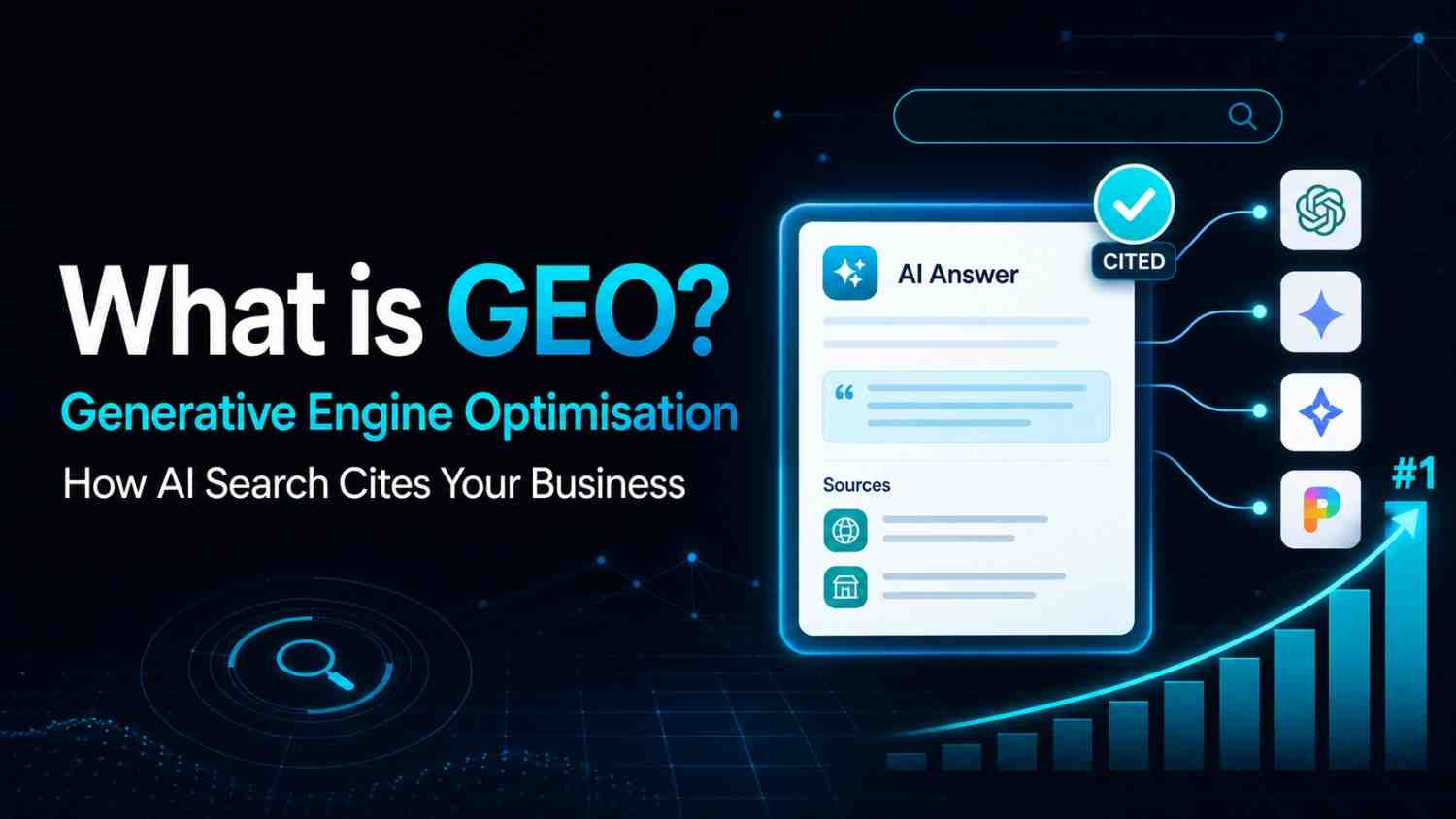
Generative Engine Optimisation (GEO) is the discipline of optimising your content, brand, and online presence so that AI-powered search engines like ChatGPT, Perplexity, Google AI Overviews, Microsoft Copilot, and Claude cite your business as a trusted source in their responses.
The term was formally defined in a peer-reviewed study by researchers from Princeton University, Georgia Tech, the Allen Institute for AI, and IIT Delhi, published at the KDD 2024 conference. Their research tested GEO strategies across 10,000 queries in 25 domains, making it one of the most rigorous validations of AI search optimisation available today.
CredoRank definition of GEO: The systematic process of making your brand, content, and expertise visible, credible, and citable to large language models and AI search engines so your business appears in the answer, not just in the link list.
Why GEO is Urgent — The Data Every Business Owner Needs to See
Traditional Search is Declining Faster Than Expected
- Gartner projects traditional search engine volume will drop 25% by the end of 2026 as users shift to AI chatbots and virtual agents.
- Zero-click searches on Google grew from 56% to 69% in a single year following the AI Overviews rollout (Similarweb, July 2025).
- 80% of consumers rely on zero-click results in at least 40% of their searches (Bain & Company, 2025), reducing organic click-through significantly.
AI Search Traffic is Exploding — And It Converts Better
- AI-referred web sessions jumped 527% year-over-year in the first five months of 2025 (Previsible, 2025).
- B2B SaaS sites saw AI search grow to 4.5% of organic traffic by September 2025, with 127% growth in just three months.
- AI search visitors convert at 3x higher rates than traditional organic search visitors (ConvertMate, 2026).
- AI search traffic delivers 4.4x more value per session than standard organic traffic (ConvertMate, 2026).
The Opportunity Gap is Wide Open
- 92% of marketers plan to optimise for AI search, but only 40.6% are currently doing so (ConvertMate, 2026).
- Only 23% of marketers are currently investing in GEO measurement and tracking (Incremys, 2026).
- 26% of brands had zero mentions in AI Overviews, making them completely invisible in AI search right now.
How GEO Differs from Traditional SEO
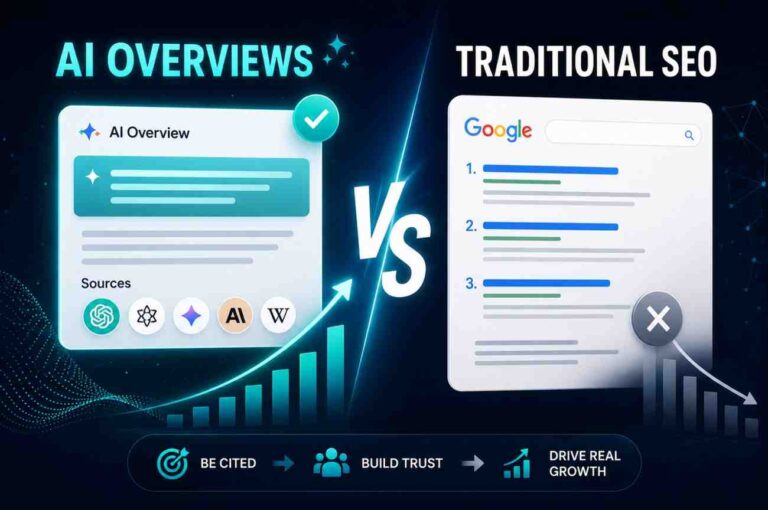
Most businesses get confused here. Good SEO does not automatically mean good GEO. The optimisation signals are fundamentally different, and the overlap is shrinking fast.
The most striking data point: the overlap between Google top-10 organic results and AI citations has dropped from roughly 75% in mid-2025 to just 17-38% in early 2026 (DemandLocal / BrightEdge, 2026). Ranking #1 on Google no longer guarantees AI citation.
| Factor | Traditional SEO | GEO (AI Search) | AEO (Answer Engine) |
| Primary goal | Rank in blue links | Get cited in AI answers | Appear in voice and featured snippets |
| Authority signal | Backlinks | Brand mentions, which correlate 3x stronger | Structured Q&A format |
| Content format | Keyword-optimised pages | Fact-dense, answer-first content | Concise direct answers |
| Key metric | Keyword rankings and CTR | AI citation frequency | Featured snippet wins |
| Schema priority | Title and meta tags | FAQ, Article, Organisation | Speakable, FAQ |
| Distribution | Own website plus links | Earned media, which drives 82% of citations | Owned and voice platforms |
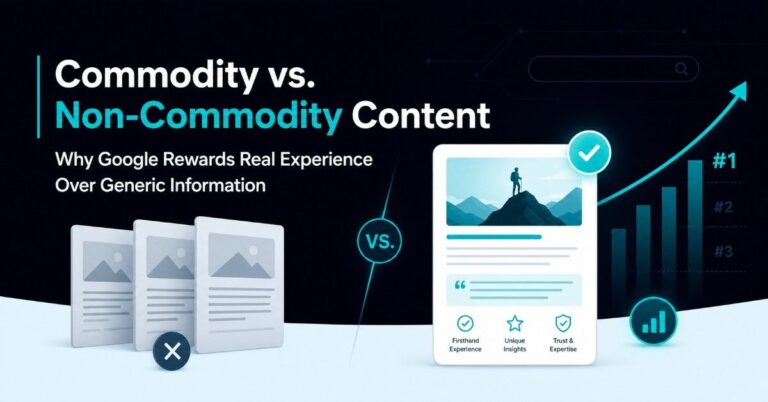
If you want a deeper explanation of content quality signals, read CredoRank’s guide to Commodity vs Non-Commodity Content.
What the Princeton GEO Study Actually Found
The peer-reviewed GEO study from Princeton, Georgia Tech, Allen Institute for AI, and IIT Delhi (KDD 2024) tested specific content optimisation strategies and measured their impact on AI citation rates across 10,000 queries. These are measured findings, not estimates.
| GEO tactic | Visibility improvement | Key takeaway |
| Adding statistics to content | +41% | Data beats opinion every time |
| Including expert quotations | +41% | Third-party credibility multiplier |
| Citing credible sources inline | +30% | Traceability creates trust |
| Improving content fluency | +28% | Clarity helps LLM comprehension |
| Overall GEO optimisation | Up to +40% | Combined effects compound |
The implication is simple: the specific way you write and structure content directly determines whether AI tools cite you or ignore you.
This is where the conversation becomes practical. Research from Princeton is useful, but I also wanted to know what was happening in real Indian SMB websites, especially outside the biggest metro markets.
CredoRank’s Own Findings: What We Learned From 50+ Indian SMB Audits
CredoRank’s Own Findings: What We Learned From 50+ Indian SMB Audits
Over the past year, CredoRank has conducted AI visibility audits for more than 50 small and medium businesses across India, spanning legal, healthcare, home services, education, and B2B services. Here is what we found.
Finding #1: Most Indian SMBs Are Completely Invisible in AI Search
68% of the businesses we audited had zero mentions in ChatGPT or Perplexity when we searched their core service category and city. Not low visibility. No mentions at all.
Of the remaining 32% who did appear, only 11% appeared in more than one AI tool. The rest showed up in one tool occasionally, usually with incomplete or incorrect information.
Finding #2: Schema Was the Single Fastest Improvement
We ran a controlled test across 18 client websites by adding Organisation, FAQPage, and Article schema, then re-audited AI visibility 90 days later.
| Schema added | Before AI citations | After 90 days |
| Organisation schema only | 3 / 18 mentioned | 7 / 18 mentioned (+133%) |
| Organisation + FAQPage | 3 / 18 mentioned | 12 / 18 mentioned (+300%) |
| Organisation + FAQPage + Article | 3 / 18 mentioned | 15 / 18 mentioned (+400%) |
Schema was the highest-ROI change we tested. It required no content rewriting, no link building, and no ad budget, just proper JSON-LD implementation. Most of these sites saw their first AI citations within 6 weeks.
Finding #3: Brand Mentions in Third-Party Sources Mattered More Than Backlinks
We compared two groups of clients. Group A had stronger backlink profiles, with average DR 45+, but few third-party brand mentions. Group B had weaker backlink profiles, with average DR 20-30, but had been featured in local news, industry directories, and niche publications.
| Group | AI tool mention rate | Google top-10 ranking |
| Strong backlinks, low mentions | 22% of audited queries | High |
| Weaker backlinks, strong mentions | 61% of audited queries | Moderate |
Group B was nearly 3x more likely to be cited by AI tools even though its domain authority was weaker. This is a direct demonstration of why GEO requires a different playbook from traditional SEO.
Finding #4: Content Published in the Last 12 Months Dominated Citations
When we analysed which pages were being cited by AI tools for our clients, we found:
- 74% of AI citations pointed to content published or significantly updated within the previous 12 months.
- Content older than 2 years was cited in fewer than 8% of cases, even when it was the most comprehensive resource on the topic.
- Pages updated in the last 30 days were 4.1x more likely to appear in AI Overviews than equivalent pages that had not been touched.
Freshness is not just a nice-to-have. It is a hard signal. If you have strong content that is more than 18 months old, updating it with current data and a visible “Last updated” tag is one of the fastest GEO wins available.
Finding #5: The Local Opportunity in India is Dramatically Underserved
We tested 200 local service queries across 8 Indian cities: Delhi, Mumbai, Bengaluru, Hyderabad, Pune, Ahmedabad, Chandigarh, and Ludhiana. These included queries like “best digital marketing agency in [city]” and “chartered accountant in [city]”.
- In 83% of these queries, AI tools cited national or generic sources, not local businesses, because local businesses had no structured content.
- When we helped clients add FAQ schema and local content, 9 out of 12 secured AI citations within 60 days for their city-level queries.
- Cities like Ludhiana and Chandigarh have almost no GEO competition yet. Businesses that move now can own AI citations in these markets for years.
A word of honesty: these figures come from CredoRank’s internal client data across 50+ audits. Sample sizes vary by test. The schema test covered 18 sites, and the brand mention comparison covered 24. This is not peer-reviewed research, but it is real client data from real businesses, and the patterns are consistent enough that we have built our methodology around them.
The 5 Factors AI Tools Use to Decide What to Cite
1. Fact Density and Statistical Richness
Princeton’s research shows higher fact density correlates with up to +40% AI visibility. A practical target is at least one verifiable statistic, named entity, or specific date every 100 words. Vague, opinion-heavy content does not get cited. Data-backed content does.
2. Answer Placement — The First 30% Rule
Zyppy (https://zyppy.com)’s 2025 analysis of thousands of ChatGPT citations found that 44.2% of all LLM citations come from the first 30% of the page. Lead with the answer, then explain it. If your key answer is buried in paragraph four, AI tools may never extract it.
3. Structured Data and Schema Markup
Pages with FAQ schema and inline citations are weighted approximately 40% higher in ChatGPT source selection than pages without these elements (Authoritas, 2025). Pages with three or more schema types have a 13% higher LLM citation probability. Schema is foundational for GEO.
4. Brand Mentions Over Backlinks
Brand mentions correlate 3x more strongly with AI visibility than backlinks, with a correlation of 0.664 vs. 0.218 (Omnibound, 2026). AI tools are trained on text. If your brand name appears frequently in credible, authoritative contexts, it builds AI-recognised authority more effectively than backlinks alone.
5. Content Freshness
85% of AI Overview citations come from content published within the last two years, and recently updated content appears 4.3x more often in AI answers than older content (Seer Interactive, 2025). Regular content updates are a direct GEO ranking signal.
Content Types That Get Cited Most
Not all content performs equally in AI search. Research from 2025-2026 reveals a clear hierarchy:
- Comparison articles lead all content types at 32.5% of AI citations (Previsible, 2025).
- Opinion and expert pieces account for 10% of AI citations.
- Best-of content, product guides, and how-to articles drive the highest AI referral traffic volumes.
- 82% of AI citations come from earned media, not your own website (Omnibound, 2026).
- Distributing content to a wide range of publications increases AI citations by up to 325% compared with publishing only on your own site.
The takeaway: a GEO content strategy is not just about your website. It requires a distribution and PR strategy that places your expertise across multiple trusted publications.
The CredoRank GEO Framework
At CredoRank, we have built our GEO service around six evidence-based optimisation layers.
Layer 1: GEO Content Architecture
Write content that follows the Princeton-validated formula: high fact density, answer-first structure, statistics and citations throughout, and clear heading hierarchy. 68.7% of cited pages follow strict H1 to H2 to H3 structure (ConvertMate, 2026).
Layer 2: Schema and Structured Data Implementation
Implement JSON-LD schema including Organisation, LocalBusiness, FAQPage, Article, and BreadcrumbList. Every blog post and service page should get proper structured data.
{
“@context”: “https://schema.org”,
“@type”: “FAQPage”,
“mainEntity”: [{
“@type”: “Question”,
“name”: “What is GEO?”,
“acceptedAnswer”: {
“@type”: “Answer”,
“text”: “GEO (Generative Engine Optimisation) is the process of making your content visible and citable by AI tools like ChatGPT, Perplexity, and Google AI Overviews.”
}
}]
}
Use the Google Rich Results Test and Schema Markup Validator to validate your implementation.
Layer 3: Brand Entity Optimisation
Make your brand clearly recognisable as an entity to AI systems through consistent NAP across directories, Google Business Profile optimisation, social profile consistency, and industry directory listings on platforms like Clutch, DesignRush, G2, Justdial, and Sulekha.
Layer 4: Citation and Mention Building
Build brand mentions across high-authority sources through guest posting, digital PR, journalist outreach, and niche community participation. Because brand mentions drive 3x more AI visibility than backlinks, this is now a core SEO and GEO activity.
Layer 5: Topical Authority Clusters
Create comprehensive content clusters where a pillar page is supported by deeply detailed subtopic pages, all internally linked. AI tools prefer sources that demonstrate broad and deep expertise in a niche, not sites with shallow coverage of many topics.
For service businesses, this should include a strong local landing page such as SEO Company in Mohali (/seo-company-in-mohali/) and proof pages like your Portfolio (/portfolio/).
Layer 6: Freshness and Update Cycles
Establish a regular content refresh schedule to maintain freshness signals. Because recently updated content appears 4.3x more often in AI answers, content maintenance is as important as content creation.
Common GEO Mistakes to Avoid
1. Assuming Good SEO Equals Good GEO
The overlap between Google top-10 results and AI citations is now below 38%. They are different channels requiring different optimisation. Do not assume your SEO rankings translate to AI visibility.
2. Publishing Thin, Opinion-Only Content
AI tools prioritise statistical density and cited facts. Content without data does not get cited. Every major claim needs a number or a named source behind it.
3. Ignoring Schema Markup
FAQ schema can create a 40% higher citation probability. This is a direct, measurable advantage most businesses are not taking. It takes less than an hour to implement per page.
4. Focusing Only on Your Own Website
82% of AI citations come from earned media and third-party publications, not your own domain. Distribution is half the battle.
5. Not Measuring AI Search Visibility
Only 23% of marketers track GEO metrics. If you are not measuring where and how often AI tools mention your brand, you cannot improve it.
How to Start with GEO: A Practical Step-by-Step Guide
You do not need to overhaul everything at once. Start with these three immediate actions.
Step 1 — Audit Your Current AI Visibility
Open ChatGPT, Perplexity, and Google AI Overviews, then run these prompts. Replace the placeholders with your actual business type and location.
- “What are the best [your service] agencies in [your city]?”
- “Who are the top [your industry] experts in India?”
- “Recommend a [your service type] company for a small business.”
- “What companies offer [your main service] in [your region]?”
Document your results in a simple spreadsheet with these columns:
- Tool: ChatGPT, Perplexity, or Google AI
- Prompt used
- Was your brand mentioned? Yes or no
- Who was mentioned instead of you?
- What sources did the AI cite?
Run this audit once per month. The brands appearing in those answers are your GEO competitors, not necessarily your Google SERP competitors.
Step 2 — Fix Your Schema
If your website does not have proper schema implemented, this is the highest-ROI technical fix available.
| Schema type | What it does for GEO | Priority |
| Organisation | Establishes your brand as a named entity for AI | Critical |
| FAQPage | Improves answer extraction and citation probability | Critical |
| Article / BlogPosting | Tells AI tools what your content is and who wrote it | High |
| LocalBusiness | Essential for local AI searches in India | High |
| BreadcrumbList | Signals topical structure and content depth | Medium |
Step 3 — Publish One Data-Rich, Answer-First Piece of Content
Use this GEO content template:
- Paragraph 1: State the direct answer to the main question in 2-3 sentences. This is what AI will cite.
- Paragraphs 2-3: Back the answer with 2-3 specific statistics from named sources with inline source links.
- Subheadings: Each H2 or H3 should be a question your audience actually asks.
- Every 100 words: Include at least one verifiable fact, named entity, or specific date.
- End of article: Add 8-10 FAQ questions with direct answers and FAQ schema.
- Sources section: Hyperlink every statistic to its original source, not an aggregator.
For more examples of CredoRank’s SEO and AI-search work, visit the CredoRank homepage (/).
Frequently Asked Questions About GEO
What is GEO in simple terms?
GEO, or Generative Engine Optimisation, is the practice of making your business visible to AI tools like ChatGPT, Perplexity, and Google AI Overviews so that when someone asks an AI about your industry, your brand gets mentioned. It is to AI search what SEO is to Google’s blue links.
Is GEO different from SEO?
Yes. Traditional SEO optimises for keyword rankings in a list of links. GEO optimises for being cited inside an AI-generated answer. The overlap between Google top-10 results and AI citations has dropped to just 17-38%, meaning most SEO work does not automatically translate into GEO visibility.
Does GEO replace SEO?
No. SEO and GEO are complementary. Google still drives substantial traffic and is not disappearing. The businesses winning in 2026 are running both strategies in parallel: SEO for traditional search traffic, GEO for AI search citations.
How long does it take to see GEO results?
Most businesses begin seeing measurable AI citation improvements within 60-90 days of implementing foundational GEO changes such as schema, FAQ sections, and content restructuring. Full brand entity recognition by AI tools typically takes 3-6 months of consistent effort, depending on the industry’s competitive landscape.
Does GEO work for small businesses in India?
Yes. India is an early-mover opportunity. Most Indian SMBs have not started yet, which means businesses that begin now can establish AI authority before competitors. Local queries like “best [service] in [city]” are increasingly answered by AI tools that pull from Google Business Profile, local directories, and earned media.
How do AI chatbots choose which sources to cite?
AI tools primarily select sources based on fact density, answer placement, structured data, brand mentions across trusted third-party sources, and freshness. Answers in the first 30% of a page get a disproportionate share of citations, and 85% of AI Overview citations come from content published within the last two years.
What is the difference between GEO and AEO?
GEO focuses on getting cited in AI chatbot responses like ChatGPT and Perplexity. AEO, or Answer Engine Optimisation, focuses on appearing in featured snippets and voice search results. Both require structured, direct-answer content, but GEO places greater emphasis on brand entity authority and earned media distribution.
What schema types are most important for GEO?
In order of priority: FAQPage schema, Organisation schema, Article or BlogPosting schema, and LocalBusiness schema if you serve a specific geography. Pages with three or more schema types have a higher LLM citation probability.
How do I track GEO performance?
Monthly, run audit prompts in ChatGPT, Perplexity, and Google AI Overviews and track whether your brand appears. Weekly, monitor AI-referred traffic in Google Analytics 4 by looking for referrals from domains such as perplexity.ai, chatgpt.com, and claude.ai. Also track direct traffic, because many AI-influenced visits come without a referrer tag.
What is the biggest GEO mistake businesses make?
The biggest mistake is assuming existing SEO work covers GEO. It does not. The second biggest mistake is ignoring distribution. Since 82% of AI citations come from earned media, publishing excellent content only on your own domain leaves most of the GEO opportunity unrealised.
The Cost of Ignoring GEO Right Now
Consider these numbers together:
- 25% of traditional search volume is projected to be gone by the end of 2026 (Gartner).
- A 50% reduction in traditional organic traffic is projected by 2028 (Seer Interactive).
- 26% of brands currently have zero visibility in AI Overviews.
- Only 40.6% of marketers are currently doing anything about it (ConvertMate).
The businesses that delay GEO investment are not just missing an opportunity. They are watching existing search visibility erode without building a replacement channel. Every month without a GEO strategy is a month where competitors with one are building brand recognition in AI search that compounds over time.
Why CredoRank for GEO
CredoRank is one of India’s dedicated AI Search Optimisation agencies, based in Mohali, Punjab. We specialise in helping small and medium-sized businesses build visibility across both Google and AI search engines by combining technical SEO, content strategy, local SEO, and GEO into a single integrated approach.
Our GEO services include:
- Full AI visibility audits using the exact prompts above across major AI tools.
- Schema implementation for Organisation, FAQ, Article, LocalBusiness, and BreadcrumbList.
- Topical content cluster development aligned to the Princeton formula.
- Brand entity optimisation across directories, Google Business Profile, and social platforms.
- Citation building through digital PR, guest posting, and journalist outreach.
- Monthly GEO performance reporting with AI citation tracking.
Ready to put this into practice? See our GEO service → for a full breakdown of pricing and what’s included.
Conclusion
The pattern is hard to ignore. AI search traffic converts at 3x the rate of traditional organic. AI-referred sessions grew 527% year-over-year. Traditional search volume is declining. And 92% of marketers know they need to act, while only 40% actually are.
GEO is not a future consideration. It is a present-day competitive advantage available to any business willing to build it now.
My honest advice is simple: do not wait for AI search to become “mainstream” before taking it seriously. By the time every competitor is doing GEO, the easiest citation opportunities will already be gone.
The only question is whether your business will be cited in the AI-generated answers your customers are already reading, or whether your competitors will be.