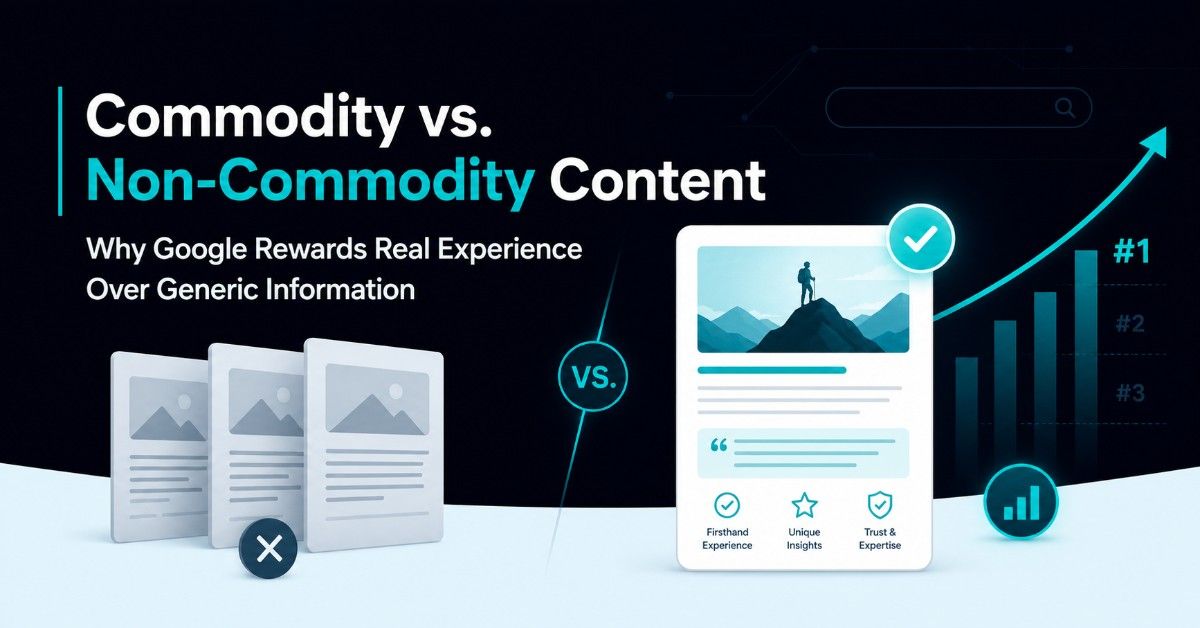
Commodity vs. Non-Commodity Content: Why Google Rewards Real Experience Over Generic Information
This concept was officially introduced by Google at Search Central Live in Toronto on April 21, 2026 — where Google’s team first publicly distinguished between commodity and non-commodity content as a framework for how their systems evaluate content quality.
The Content Paradox Most Websites Face
You’re probably publishing more content than ever. Blog posts weekly, guides monthly, resources constantly. Yet here’s the uncomfortable truth: most of it is invisible to Google, ignored by your audience, and driving almost no real results.
The problem isn’t your writers or your effort. It’s your content strategy itself.
You’re creating commodity content when Google explicitly rewards non-commodity content. The good news? There’s still a narrow window to break free and build something that genuinely matters.
What Is Commodity Content? (And Why Most Websites Create It)
Commodity content is information that could be written by anyone, about anything, for no particular reason. It’s the “7 Tips for First-Time Homebuyers” post that looks identical across 100 real estate websites. It’s the “What Is Content Marketing?” guide that restates information already published across the web.
Here’s the defining characteristic: if a competitor could produce functionally identical content by following the same brief, it’s commodity.
Most websites create commodity content without realizing it. You commission a writer with the brief “write about buying running shoes, 2,000 words, target these keywords.” The writer researches, aggregates information from other articles, and produces a competent piece that says what everyone else says.
That’s not a failure of writing quality. That’s a structural failure of strategy.
The Commodity Content Trap: How It Starts
The trap begins with production-first workflows. Your content calendar is built around keyword volume targets and publishing frequency, not around unique angles or genuine expertise. You ask: “What keywords should we rank for?” instead of “What can we say that no other site could say?”
Template dependency makes it worse. The same structure—introduction, definition, list, call-to-action—appears on every post. An article about kitchen renovation ends up shaped identically to one about bathroom design. Both are commodity content, regardless of how well they’re written.
Most sites then double down by using AI to accelerate the problem. You brief Claude or ChatGPT with a keyword and topic, and it generates the structural average of what already exists on that subject. The experiential insight that would make the piece unique was never gathered, so it never appears.
The result? You publish 52 pieces per year that rank nowhere, build no authority, and convince no one that you know what you’re doing.
Non-Commodity Content: What Google Actually Rewards
Non-commodity content cannot be replicated because it’s built on something no other source has access to: direct experience, original testing, real data, or specialist insights earned through years of actual work.
For a product review site, this looks completely different. It’s not “How to Choose Running Shoes”—it’s “I Tested 10 Running Shoes for 8 Weeks: Here’s Exactly Where Each One Failed.” It’s not “Best Practices for Kitchen Design”—it’s “Why I Waived the Inspection and Found a $15k Problem: A Real Homebuyer’s Story.”
This content takes weeks to produce, not hours. You can’t generate it from a brief. It requires:
- Real product testing and genuine data from actual use
- Mistakes you’ve actually made and lessons learned from them
- Original analysis that required actual thinking, not aggregation
- Your authentic perspective on what works versus what conventional wisdom claims
Google’s AI systems can identify this. Readers can feel it. Competitors can’t replicate it because they don’t have your specific experience.
Why Google Deprioritizes Commodity Content
Google doesn’t explicitly penalize commodity content. It just doesn’t reward it. Commodity pieces fail to accumulate the signals that build real authority: inbound links from sites that found something genuinely worth referencing, return visitors who found something that solved their actual problem, social engagement from people who discovered something they couldn’t find elsewhere.
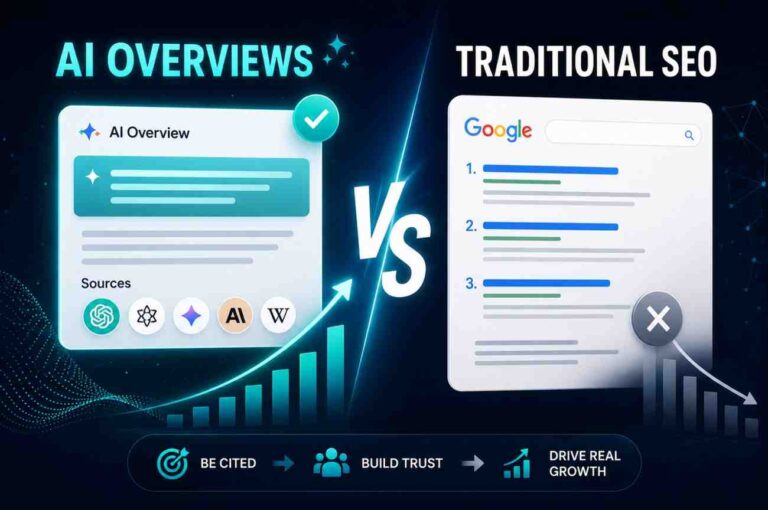
The real blow came with AI Overviews. Google now answers commodity queries directly in the search results themselves. If your piece just restates “what is a mortgage” or “best running shoes for beginners,” Google’s AI synthesizes that information in the SERP before anyone clicks your link.
Non-commodity content is harder to subsume into an AI-generated summary because it doesn’t exist elsewhere in the same form. Original testing, specific outcomes, personal experiences—these can’t be synthesized from existing web content. They create a reason to click. This is exactly why Generative Engine Optimization (GEO) has become a critical strategy — ensuring your content gets cited by AI platforms, not replaced by them.
The Real Problem: Can You Actually Scale Non-Commodity Content?
Here’s where most websites get stuck. You read this and think: “Okay, but can we do this at scale? We have a publishing schedule to maintain.”
The honest answer: non-commodity content doesn’t scale the way commodity content does. That’s the entire point. It shouldn’t.
But here’s what you can do:
Reduce commodity content by 50%. Cut the “7 Tips” posts, the definitional guides, the surface-level how-tos. These aren’t helping you anyway. Deprioritize them internally and in your content calendar.
Increase non-commodity content by 50%. Invest in real product testing. Document actual results and experiences. Share genuine insights with real data. Publish honest reflections on what works and what doesn’t.
A single deep-dive review or case study that took four weeks to produce will outrank 10 quick posts published in the same timeframe. It will generate more links, more shares, more trust. It will actually convince potential customers that you know what you’re doing.
How to Shift Your Content Strategy
The change doesn’t happen at the writing stage. It happens at the brief stage.
Start with expertise, not keywords. Before you write anything, interview your best expert or practitioner. What do they see that others miss? What mistake do they see people make repeatedly? What surprised them recently? Start there. Let the content emerge from genuine insight, not from a keyword list.
Commission from experts, not generalists. Someone with 15 years of hands-on experience can write something a generalist never could. Their specific knowledge is the non-commodity part. Make them the author, not just the interview subject.
Use AI to assist expertise, not replace it. Claude can structure messy notes, organize research, improve prose flow, and create outlines. AI shouldn’t generate the insight. It should accelerate the communication of insight that a real human already possesses. That’s exactly what AI-optimized content looks like when done right — human expertise, enhanced by AI structure and semantic optimization.
Accept that non-commodity content takes time. If a blog post took your team four weeks to produce because you were testing products, gathering real data, and thinking deeply about what it means—that’s a feature, not a bug. The effort is visible and valuable.
Real Example: Commodity vs. Non-Commodity Content
Commodity version: “5 Ways to Choose the Right Running Shoes” – generic tips about fit, cushioning, terrain, budget, and brand reputation.
Non-commodity version: “I Tested 10 Running Shoes for 8 Weeks and Documented Every Failure Point: Here’s What Actually Matters” – specific product outcomes, what worked versus hype, documented failures, real wear patterns, genuine insights.
One could be written in a day. One took eight weeks because you had to actually test the products and analyze the data. Google knows the difference. So does your potential customer reading it. See how this approach drives real results in our portfolio.
The Uncomfortable Truth About Your Content Right Now
Most of what your website publishes is invisible. It ranks nowhere, convinces no one, and builds no authority. Not because of quality or effort from your writers, but because the strategy was wrong from the beginning.
The sites that win long-term aren’t the ones publishing the most. They’re the ones publishing the deepest. They’re sharing real experience, real data, real failures, real wins. They’re building genuine authority, not chasing keyword volume.
The window to make this shift is narrow. Most competitors won’t. They’ll keep optimizing commodity content, keep wondering why it doesn’t work, keep blaming Google’s algorithm instead of their strategy.
By the time they realize what happened, the authority gap will be impossible to close.
What to Do Next
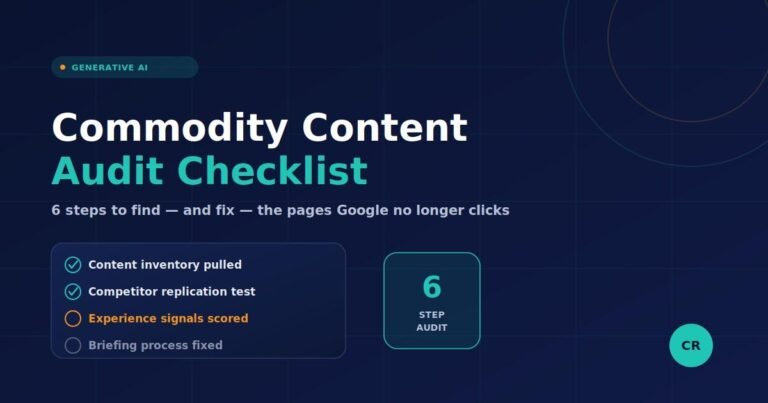
Audit your existing content library with one simple question: “Could a competitor publish something functionally identical by following the same brief?” If the answer is yes, that piece is commodity. A proper technical SEO audit can also reveal which of your existing pages are underperforming and why.
Then make a choice. Improve those pieces by adding genuine insight, consolidate them into one authoritative resource, or quietly deprioritize them.
For new content: start from what you actually know and have genuinely experienced. Let the content be built from expertise, assisted by AI, written by real practitioners. Publish less frequently. Let each piece take the time it needs. Our SEO Playbook walks you through exactly how to build this kind of content system from scratch.
That’s how you build authority that actually matters.
CredoRank: We help businesses build non-commodity content strategies that actually rank and convert. Stop creating invisible content. Start building real expertise. Get your free audit today.